A professional information and consulting platform for agriculture, forestry, animal husbandry, fishery and related light industry sectors;

ECHA PFAS Curbs Tighten Waterproof Resin Exports





On August 2, 2026, the European Chemicals Agency (ECHA) introduced an emergency restriction that brings 12 fluorinated polymer substances, including key components used in waterproof resins, into REACH Annex XVII control. For waterproof resin products shipped to the EU, the immediate requirement for a complete PFAS declaration and a third-party test report turns this from a regulatory update into a practical trade and delivery issue, especially for Chinese exporters serving EU distributors, construction contractors, and building materials importers.
What Changed on August 2
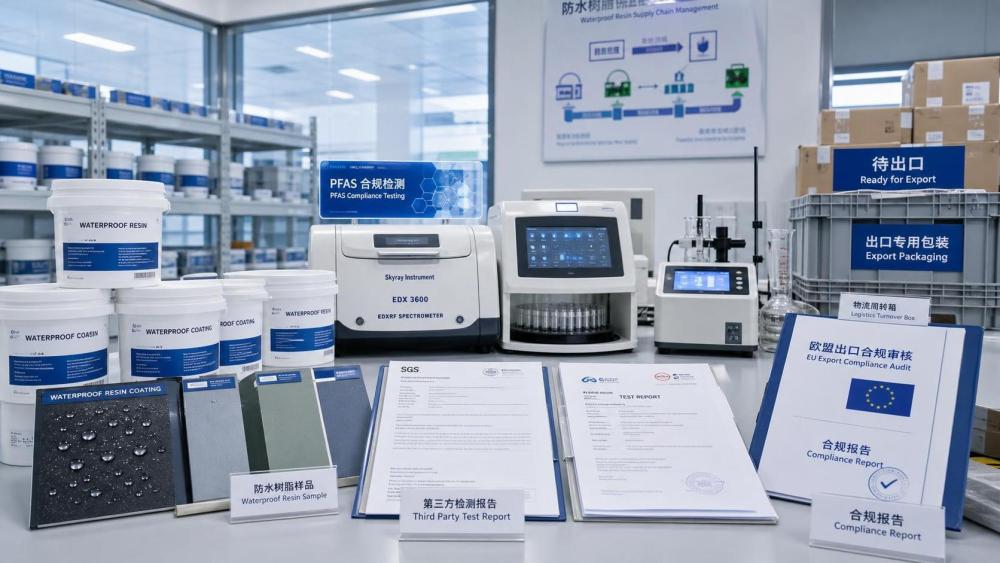
The confirmed facts are limited but clear. ECHA issued the restriction on August 2, 2026. The measure adds 12 fluorinated polymer substances to REACH Annex XVII control, and the scope includes key waterproof resin components. From the date of issuance, waterproof resin products exported to the EU are required to provide a complete PFAS declaration together with a third-party testing report. The event summary also states that this directly affects the supply qualification and customs clearance timeliness of Chinese waterproof resin exporters dealing with EU distributors, building contractors, and building materials importers.
Where the Pressure Appears First in the Supply Chain
Export shipments facing document-based screening
From an industry perspective, exporters are the first group likely to feel the impact because the new requirement is tied directly to products entering the EU market. The immediate pressure point is not only product composition, but also whether shipments are accompanied by the required PFAS declaration and third-party test documentation. In practical terms, this puts supply eligibility and clearance timing under closer scrutiny.
EU-facing buyers and channel partners checking supplier readiness
EU distributors, building contractors, and building materials importers are explicitly connected to this change through supply qualification. Analysis shows that these downstream buyers may place greater weight on document completeness before confirming procurement, receiving goods, or maintaining approved supplier status. For businesses that depend on repeat orders or project-based supply, compliance materials may become part of routine commercial review.
Testing and compliance support becoming a transaction prerequisite
What deserves closer attention is the role of third-party testing and compliance documentation in the trade flow. Because a third-party test report is now required for waterproof resin products shipped to the EU, testing-related service capacity, document turnaround, and consistency between declarations and technical files may become operational concerns for manufacturers, exporters, and trading intermediaries.
What Companies Should Review Now
Check whether product files can support a full PFAS statement
Analysis shows that companies shipping waterproof resin products to the EU should first verify whether their current product dossiers, raw material disclosures, and internal formulation records are sufficient to support a complete PFAS declaration. This is especially relevant where key resin components may fall within the newly controlled group described in the event summary.
Reassess testing arrangements and document lead time
Observably, the requirement for third-party testing changes the timing of export preparation. Businesses should pay close attention to whether existing testing arrangements can support shipment schedules, bid submissions, and customs documents without delay. Since the input does not provide further execution detail, this should be understood as a compliance checkpoint to monitor closely rather than a fully defined enforcement process.
Watch supply qualification and tender document changes
From an industry perspective, the direct reference to EU distributors, contractors, and importers suggests that supplier approval conditions may tighten in parallel with formal regulatory expectations. Companies should therefore monitor whether procurement files, technical submissions, and customer qualification requests begin to ask for PFAS declarations or third-party reports as standard entry requirements.
Prepare for delivery and traceability questions
It is more appropriate to understand this as a rule change that can spill over into delivery management. Where customs timing and supply qualification are affected, companies may need to pay closer attention to shipment documentation consistency, after-sales traceability, and the ability to explain test and declaration records when questioned by counterparties.
How This Signal Should Be Read
This section is an editorial observation. At this stage, the development reads less like a distant policy discussion and more like an active compliance signal tied to immediate export practice. The wording in the event summary points to a change that already matters for documentation, qualification, and clearance. At the same time, the available facts do not yet define every execution detail, so the market still needs to watch how compliance expectations are expressed in customer requests, customs handling, and supporting documentation reviews.
A Practical Reading of the Current Development
In summary, this update matters because it connects PFAS control under REACH Annex XVII directly with the export readiness of waterproof resin products entering the EU. The clearest current takeaway is not a broad market conclusion, but a narrower operational one: documentation, testing, and supplier qualification may now move to the front of the transaction process. It is more appropriate to understand this as an already relevant compliance change with further implementation details still worth tracking.
Basis of This Article and What Still Needs Verification
This article is generated from the user-provided news title, event date, and event summary. Source types commonly relevant to developments of this kind include official announcements, releases from regulatory authorities, customs or trade administration information, industry association updates, standards documents, and reporting by authoritative media. A specific official source link was not provided in the input, so that point remains to be verified on an ongoing basis. Further observation is still needed on detailed implementation language, certification and testing interpretation, tender document changes, market feedback, and how companies are handling execution in actual export workflows.
Related News
- 00
0000-00
How Insulation R-Value Affects Chemical Processing Energy Costs and ROI - 00
0000-00
How to Evaluate Solvent Free Waterproofing for Low-VOC Roofing and Concrete Projects - 00
0000-00
ECHA PFAS Curbs Tighten Waterproof Resin Exports - 00
0000-00
How to Evaluate Bituminous Waterproofing Wholesale Options for Project Cost and Performance - 00
0000-00
Polyurethane Waterproofing Resin Wholesale: What Affects Price, MOQ, and Project Suitability?
Dr. Aris Chem
Weekly Insights
Stay ahead with our curated technology reports delivered every Monday.
News Recommendations
The five pillar industries provide end-to-end industry intelligence.
 Author :Lina CleanHow to Qualify a Portable Particle Counter Supplier for GMP Cleanroom MonitoringChoose a portable particle counter supplier with proven GMP calibration traceability, data integrity, responsive service, and lifecycle value for reliable cleanroom monitoring.
 Author :Dr. Aris ChemHow Polycarboxylate Superplasticizers Cut Concrete Water Demand Without Sacrificing StrengthConcrete water reduction ratio polycarboxylate solutions help lower water demand while preserving strength, workability, stability, and production reliability. Explore smarter PCE evaluation.
 Author :Dr. Hideo TanakaSelecting ATEX Pressure Sensors for Zone-Classified Gas and Dust EnvironmentsATEX pressure sensor selection guide for Zone-classified gas and dust environments. Explore Ex markings, temperature limits, protection methods, and certified installation essentials.
 Author :Vibration AnalyzersIP67 vs IP69K Sensor Ratings: Selecting Protection for Middle East Dust and WashdownIP67 vs IP69K sensor rating Middle East: compare dust, immersion and hot washdown protection to select reliable sensors for demanding regional conditions.
 Author :Dr. Elena BioChemical Industry Outlook: Feedstock Costs, Supply Risks, and Demand SignalsChemical industry outlook: assess feedstock costs, supply risks, and demand signals to strengthen sourcing, pricing, inventory, and resilient growth.
 Author :Vibration AnalyzersHow to Select an Edge Computing Sensor Gateway for Low-Latency Industrial MonitoringEdge computing sensor gateway selection guide for low-latency industrial monitoring. Compare compatibility, reliability, security, and integration to improve uptime.
 Author :Dr. Elena BioFood Packaging Policy Updates: What Compliance Teams Must Track in 2026Food packaging policy updates for 2026: build a market-ready compliance system for food contact safety, recycled content, labeling, supplier evidence, and packaging claims.
 Author :Dr. Aris ChemMortar Bond Strength Test: Methods, Failure Modes, and Acceptance CriteriaMortar bond strength test guide: compare methods, interpret failure modes, and set project-specific acceptance criteria for reliable masonry performance.
 Author :Vibration AnalyzersSmart Factory Automation News: Which Investment Signals Matter to Discrete Manufacturers?Smart factory automation news: discover the investment signals that help discrete manufacturers improve quality, flexibility, uptime, and ROI without costly disruption.
 Author :Dr. Elena BioHow to Evaluate Fishery Technology Suppliers in Europe for Fleet Upgrade ProjectsFishery technology supplier Europe guide: evaluate fleet upgrade partners for compatibility, compliance, lifecycle cost, service coverage, data security, and risk-adjusted value.
 Author :Dr. Elena BioSingle-Use Bioreactor Cost: What Drives Pricing and Total Cost of Ownership?Single use bioreactor cost explained: compare purchase price, bag expenses, automation, service, and total cost of ownership for smarter procurement decisions.
 Author :Dr. Elena BioAgricultural Specification Guide: What pH Levels Do Different Crops Need?Agricultural specification guide pH level: discover ideal soil pH ranges for major crops, avoid nutrient lock-up, and improve yield with smarter testing and amendments.
 Author :Dr. Aris ChemHow to Evaluate a Powder Polycarboxylate Ether Factory for Reliable Concrete SupplyEvaluate a powder polycarboxylate ether factory with practical guidance on quality control, concrete compatibility, supply reliability, and total cost performance.
 Author :Dr. Aris ChemConcrete Strength Price: How Mix Grade, Cement Content, and Admixtures Affect CostConcrete strength price explained: compare mix grade, cement content, aggregates, admixtures, and delivery costs to secure reliable performance and better value.
 Author :Dr. Aris ChemSelf-Leveling Flowability Metrics: How to Predict Spread and Placement StabilitySelf-leveling flowability metrics reveal how spread, flow retention, rheology, and segregation resistance shape stable placement—explore a practical evaluation framework.
 Author :Dr. Elena BioHow to Evaluate an Industrial Supplier Directory for Reliable Sourcing DecisionsIndustrial sourcing information helps buyers assess supplier directory quality, verify lead relevance, and make smarter, lower-risk sourcing decisions. Discover practical evaluation steps.
 Author :Lina CleanHow to Evaluate Low Energy Cleanrooms for HVAC Efficiency and Airflow ControlLow energy cleanrooms: learn how to evaluate HVAC efficiency, airflow, pressure cascades, recovery tests, and lifecycle costs for reliable contamination control.
 Author :Dr. Elena BioSupplier Capability Assessment Criteria: A Practical Scorecard for Procurement TeamsSupplier capability assessment criteria: build a practical procurement scorecard to verify quality, capacity, traceability, delivery resilience, and supplier risk controls.
 Author :Lina CleanHEPA Filtration in Europe: Which EN 1822 Requirements Matter for Cleanroom Projects?HEPA filtration Europe guide: understand EN 1822 H13/H14 requirements, MPPS testing, leak scans and cleanroom integrity checks for confident project specifications.
 Author :Dr. Elena BioSupplier Capability Assessment Checklist: 12 Criteria to Reduce Sourcing RiskSupplier capability assessment checklist: explore 12 essential criteria to evaluate quality, capacity, compliance, traceability, and delivery reliability—reduce sourcing risk and build resilient supplier partnerships.
 Author :Lina CleanHow to Set Cleanroom Environmental Alert Limits for Lithography Yield ControlLithography environment control alerts for cleanroom yield: learn to set warning and action limits that detect drift early, reduce false alarms, and protect wafers.
 Author :Dr. Elena BioAgriculture Supply Chain News: What Disruptions Mean for Crop Input BuyersAgriculture supply chain news helps crop input buyers manage fertilizer, seed, pesticide, and logistics disruptions with smarter sourcing strategies and stronger supply resilience.
 Author :Marcus AeroEurope Aviation MRO Market Trends 2026: What Airlines and Suppliers Should WatchAviation MRO market trends 2026 Europe reveal where engine bottlenecks, labor shortages, digital upgrades, and supplier partnerships will reshape airline costs, capacity, and competitive advantage.
 Author :Dr. Elena BioHow to Evaluate Wastewater Treatment Solutions for Compliance, Cost, and Site NeedsSolution evaluation resources for wastewater treatment: learn how to compare compliance, lifecycle cost, and site constraints to choose reliable systems with less risk.
 Author :Dr. Elena BioWhat Procurement Product Evaluation Resources Help Buyers Compare Vendors Faster?Procurement product evaluation resources help buyers compare vendors faster with spec sheets, scorecards, cost models, and compliance checks that reduce risk, delays, and hidden costs.
 Author :Dr. Aris ChemHow Insulation R-Value Affects Chemical Processing Energy Costs and ROIInsulation r-value chemical metrics cost analysis shows how better insulation cuts energy spend, improves process stability, and delivers faster ROI in chemical processing.
 Author :Marcus AeroLightweight Material Innovations in Manufacturing: What Engineers Should WatchLightweight material innovations news manufacturing: explore which composites, alloys, and bio-based polymers are truly production-ready, lower risk, and worth engineers’ attention now.
 Author :Dr. Elena BioCrop Input Buyer Guide: How to Compare Fertilizer, Seed, and Chemical OptionsCrop input buyer guide for smarter fertilizer, seed, and chemical decisions. Compare real cost, field performance, compliance, and supplier reliability to protect farm margins.
 Author :Dr. Elena BioHow to Evaluate Animal Nutrition Purchasing Specifications for Ingredient QualityPurchasing specification resources animal nutrition teams use should define quality, safety, traceability, and receiving standards—learn how to compare ingredient specs and avoid costly sourcing mistakes.
 Author :Dr. Elena BioHow to Evaluate Animal Feed Additives for Livestock Performance and Cost ControlAnimal feed additives: learn how to compare function, inclusion cost, performance impact, and supplier reliability to improve livestock results and control feed spend.
 Author :Marcus AeroHow to Use Airframe Fastener Fatigue Data to Predict Joint Life and Inspection IntervalsAirframe fastener fatigue data explained in a practical guide to predict joint life, assess crack growth, and set safer inspection intervals with more confidence.
 Author :Lina CleanChina Customs Launches Fast-Track Export Clearance for FFU and HEPA FiltersChina Customs launches fast-track export clearance for FFU and HEPA filters, targeting 48-hour processing at key ports. Explore how this pilot boosts compliance confidence and delivery predictability.
 Author :Marcus AeroHow to Evaluate an Aircraft Heat Exchanger Supplier for Aerospace ProgramsAircraft heat exchanger supplier selection can make or break aerospace programs. Learn how to assess compliance, quality systems, engineering depth, lead times, and total cost before award.
 Author :Lina CleanChina-UAE Direct Sea Route Cuts FFU and HEPA Lead Times by 7-10 DaysChina-UAE direct sea route cuts FFU and HEPA lead times by 7-10 days, helping Gulf buyers improve cleanroom supply planning, project timing, and delivery stability. Learn what it means now.
 Author :Dr. Elena BioFood Grade Plastics Compared: How to Evaluate Safety, Heat Resistance, and CostMaterial comparison guide for food grade plastics: compare safety, heat resistance, and cost to choose the best resin for your application.
 Author :Lina CleanChina Imposes Temporary Helium Export Controls, Raising Supply Chain Questions for FFU and HEPA MakersChina helium export controls raise urgent questions for FFU and HEPA makers. Learn how compliance, cleanroom testing, and delivery stability may be affected.
 Author :Dr. Elena BioHow Single-Use Tech Impacts CDMO Efficiency, Cost, and Scale-Up DecisionsImpact of single-use tech on CDMO efficiency, cost, and scale-up decisions—discover key trade-offs, hidden savings, and smarter capacity planning.
 Author :Lina CleanChina's Helium Export Ban Puts FFU and HEPA Testing Under PressureChina’s helium export ban is pressuring FFU and HEPA testing, threatening calibration, certification, and delivery for exporters.
 Author :Dr. Aris ChemWhat Affects Adhesion Strength on Wet Concrete Coatings?Adhesion strength on wet concrete coating depends on moisture, surface prep, porosity, curing, and chemistry—learn how to choose the right system.
 Author :Lina CleanIndia Eyes NIAS Rules for Food Packaging ExportsIndia’s NIAS draft rules could reshape food packaging exports and cleanroom filtration compliance. Learn what FFU and HEPA suppliers must watch now.