A professional information and consulting platform for agriculture, forestry, animal husbandry, fishery and related light industry sectors;

When pharma grade piping wholesale causes GMP headaches





When pharma grade piping wholesale decisions go wrong, quality teams and safety managers usually feel the damage first. What looks like a purchasing shortcut can quickly turn into a GMP issue: incomplete material traceability, weld defects, poor drainability, contamination traps, sanitation failures, and documentation gaps that become visible only during qualification, audit, or deviation review.
For this audience, the core question is not simply where to buy pipe. It is how to prevent sourced piping components from becoming a compliance, product safety, and operational reliability problem later. In regulated production environments, the real cost of a low-visibility supply decision is rarely the purchase price. It is the accumulated burden of re-inspection, rework, line shutdowns, change control complexity, failed validation, and audit exposure.
This article focuses on the practical search intent behind the topic: how quality and safety professionals can identify hidden risks in wholesale sourcing, what evidence they should request before approval, and how to judge whether a supplier can support GMP expectations rather than merely claim “pharma grade” status.
Why wholesale sourcing becomes a GMP problem faster than many teams expect
The phrase “pharma grade” often creates a false sense of security. In practice, wholesale supply models can introduce variability that is not obvious at the quotation stage. Different production batches, inconsistent finishing standards, subcontracted welding, mixed documentation practices, or incomplete quality agreements may all sit behind one simple product description.
For quality control personnel, this matters because GMP compliance depends on evidence, consistency, and control. A piping system is not just a mechanical asset. It is part of the product contact pathway, the cleaning pathway, and the contamination control strategy. If the sourced materials or fabrication methods are inconsistent, the entire system may become harder to validate and harder to defend during inspection.
Safety managers view the same issue through a broader operational lens. Piping defects or specification mismatches can contribute to pressure concerns, leakage, cleaning chemical incompatibility, dead-leg formation, microbiological risk, or maintenance hazards. These are not abstract engineering details. They affect worker safety, product integrity, and continuity of production.
The main search intent behind “When pharma grade piping wholesale causes GMP headaches” is therefore highly practical: readers want to understand how sourcing mistakes happen, what warning signs appear early, and what checks can stop those issues before installation or use.
What quality and safety teams care about most before approving a supplier
Target readers in quality control and safety management are rarely looking for generic descriptions of stainless steel pipe. They want to know whether a wholesale supplier can reliably meet regulated manufacturing expectations. That means three things matter above all: traceability, process consistency, and audit-ready documentation.
First, traceability must go beyond a label or a verbal assurance. Teams need confidence that materials can be traced back to heat numbers, mill certificates, surface treatment records, and fabrication history where applicable. If a supplier cannot clearly connect delivered components to original manufacturing and finishing data, every downstream quality decision becomes weaker.
Second, consistency is often more important than marketing language. A supplier may present one polished sample but deliver products from multiple uncontrolled sources. Quality teams need to know whether dimensions, internal surface finish, passivation quality, weld profile, and hygienic design characteristics are repeatable across lots.
Third, documentation quality often predicts operational pain. When document packages are late, incomplete, mismatched, or manually corrected, that is usually not a paperwork-only issue. It may indicate weak process control, poor supplier oversight, or fragmented production responsibilities. In a GMP environment, bad paperwork is often a warning sign for deeper technical risk.
Where wholesale piping decisions typically fail in real regulated environments
Many GMP headaches begin with a gap between the stated specification and the actual application. A purchasing team may source products described as suitable for pharmaceutical use, yet the delivered piping may not match the hygienic, mechanical, or validation requirements of the process system.
One common failure point is material substitution. Even small changes in alloy source, elastomer grade, surface condition, or fitting geometry can affect corrosion resistance, cleanability, extractables, or system compatibility. If substitutions occur without formal approval and documented evaluation, the site may inherit unplanned validation and change control work.
Another frequent issue is weld quality. Orbital welding may be expected, but field reality may include variable welder skill, inconsistent purge control, discoloration, lack of borescope inspection, or weak weld logs. In pharmaceutical and adjacent regulated production, poor welds create more than appearance issues. They may create microbial harborage points, rough surfaces, flow disruption, or cleaning difficulties.
Surface finish claims also deserve scrutiny. A certificate showing a target roughness value does not always prove that all internal surfaces, fittings, and weld areas meet the same standard. If the internal finish varies across elbows, tees, reducers, valves, and tubing sections, cleaning performance may become unpredictable. That directly affects GMP confidence.
Drainability and dead-leg risk are also regularly overlooked during wholesale sourcing. Components that look dimensionally acceptable in isolation can create poor system geometry once assembled. For quality and safety teams, this matters because residual liquid, trapped cleaning agents, or stagnant product can increase contamination risk and complicate both sanitation and investigation work.
Why documentation gaps create outsized compliance pressure
Among all the issues tied to pharma grade piping wholesale, documentation failures are often the most visible during audits and the most frustrating during qualification. A line may look properly installed, but if the supporting records are weak, the system remains difficult to release with confidence.
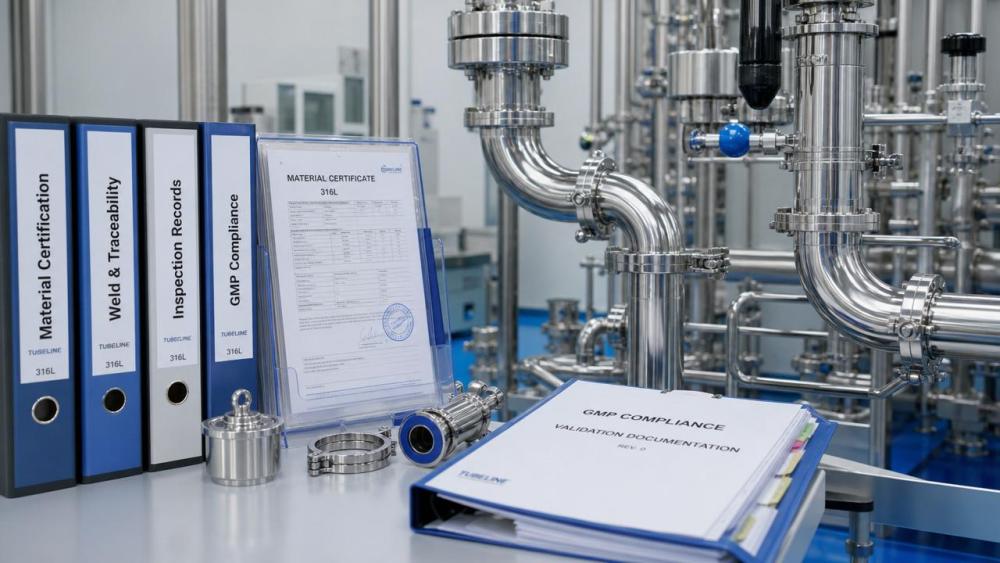
Key documents usually include material test reports, certificates of conformity, weld logs, welder qualifications, surface finish records, passivation data where relevant, pressure test reports, inspection records, and component traceability maps. If these arrive late or cannot be matched clearly to installed locations, quality teams may be forced to reconstruct evidence under time pressure.
This creates a chain reaction. Qualification timelines slip. Deviations increase. Temporary risk assessments multiply. Change control becomes more complex because the installed asset no longer has a clean documentation baseline. During an inspection, the problem is not just missing paper. It is the inability to prove that the system was built and controlled as required.
For safety managers, documentation also supports maintenance safety and incident response. If component identity, pressure ratings, service compatibility, and modification history are unclear, isolation planning and repair decisions become riskier. Good records are not administrative overhead. They are part of operational control.
How to evaluate a supplier beyond the words “pharma grade”
Quality and safety professionals should treat “pharma grade” as a starting claim, not a decision criterion. The useful question is whether the supplier can demonstrate a controlled manufacturing and supply process that aligns with the user’s GMP expectations.
Begin with supplier transparency. Ask who actually manufactures the pipe, fittings, and related assemblies. Clarify whether finishing, welding, passivation, electropolishing, inspection, and packaging are performed in-house or outsourced. Wholesale distributors can be valuable partners, but only if they can clearly manage and document their upstream chain.
Next, examine specification discipline. A capable supplier should be able to discuss alloy grades, dimensional tolerances, internal surface finish standards, weld acceptance criteria, hygienic design features, and packaging controls without relying on vague generalities. If answers stay at brochure level, the risk is high.
It is also important to test document responsiveness early. Before any major order, request a sample quality package. Review whether certificates are complete, legible, traceable, and internally consistent. Look for lot mapping, revision control, and alignment between commercial descriptions and technical records. A weak sample package often predicts a difficult project.
Finally, evaluate change communication. Ask how the supplier handles material substitutions, source changes, process deviations, and nonconforming product. A supplier that cannot clearly explain notification and approval pathways is more likely to create GMP surprises later.
A practical pre-approval checklist for quality control and safety teams
To reduce risk, readers in this audience usually need actionable screening criteria rather than broad sourcing advice. The following checkpoints are especially useful before approving a wholesale supplier or releasing a purchase order.
1. Confirm material traceability. Verify that heat numbers, mill certificates, and lot identifiers can be linked to delivered components and, where needed, to installed locations.
2. Review hygienic design suitability. Check whether component geometry supports cleanability, drainability, and the intended sanitation method. Do not review straight pipe alone; assess fittings, valves, reducers, and weld areas.
3. Define weld quality expectations. Require clear standards for welding method, purge control, inspection, acceptance criteria, and weld record retention.
4. Validate surface finish evidence. Confirm how roughness is measured, where it is measured, and whether fittings and fabricated sections are included in the same quality expectation.
5. Examine packaging and handling controls. Contamination can occur before installation. End caps, protective wrapping, storage conditions, and transport practices should be reviewed, especially for product-contact components.
6. Audit documentation capability. Request sample document packs in advance and assess whether the supplier can consistently provide them at the required timing.
7. Establish change notification rules. No material or process substitution should occur without formal communication, review, and approval.
8. Align on deviation and nonconformance management. Suppliers should have a defined escalation process for defects, missing records, and out-of-spec conditions.
9. Clarify application boundaries. Ensure the purchased piping is suitable for the specific media, temperature, pressure, cleaning chemistry, and regulatory context of the user site.
10. Involve cross-functional reviewers early. Quality, engineering, validation, production, and safety should all contribute before the sourcing decision is finalized.
How sourcing mistakes show up later during operation, cleaning, and audits
One reason this topic has strong search value is that many piping problems stay hidden until after commissioning. A system may pass initial mechanical checks yet still create repeated GMP headaches in use.
During operation, warning signs may include unexplained particulate findings, recurring bioburden issues, slower cleaning verification, abnormal corrosion patterns, or repeated maintenance around the same joints and fittings. These signals should prompt teams to revisit source records and installation history, not just treat symptoms locally.
During cleaning and sanitation, poor internal finish or bad drainability can produce inconsistent results from cycle to cycle. This may lead to longer cleaning times, more aggressive chemistry, repeated swabbing, or uncertain residue outcomes. In regulated production, each of these consequences increases both cost and compliance burden.
During audits, inspectors often follow the logic chain from installed equipment to documented control. If records are fragmented or if component pedigree cannot be demonstrated clearly, even a technically serviceable system can become a compliance concern. The weakness lies in the inability to prove control, not merely in the hardware itself.
What a stronger purchasing strategy looks like in practice
The most effective response is not to avoid wholesale purchasing altogether. It is to manage wholesale sourcing with the same discipline applied to other critical GMP inputs. That means moving piping decisions out of a purely price-driven procurement lane and into a cross-functional risk-based review process.
Start by classifying piping components according to product contact criticality, cleaning impact, and process risk. Not every component requires the same depth of control, but critical lines should trigger stricter supplier qualification, technical review, and incoming verification.
Then build a concise but enforceable supplier requirement set. This should cover technical specifications, documentation deliverables, packaging standards, approval requirements for changes, and rights to audit or review evidence. A short, clear requirement document is often more effective than broad expectations that remain open to interpretation.
Finally, close the loop after delivery. Incoming inspection should confirm not only dimensions and appearance but also traceability, documentation completeness, and packaging integrity. If issues appear, they should be logged in a way that informs future supplier scoring and sourcing decisions.
Conclusion: wholesale savings mean little if they create GMP uncertainty
For quality control personnel and safety managers, the lesson is straightforward: pharma grade piping wholesale is not risky because it is wholesale. It becomes risky when supplier capability, technical fit, and documentation control are assumed rather than verified.
The most helpful way to evaluate these purchases is to ask what evidence will still matter six months later during qualification review, deviation investigation, maintenance work, or an external audit. If traceability is weak, weld quality is uncertain, documentation is inconsistent, or hygienic suitability is not clearly demonstrated, the apparent savings can quickly turn into GMP headaches.
In regulated environments, good piping procurement is really a quality assurance decision with safety consequences. Teams that review wholesale sources through that lens are more likely to protect product integrity, maintain operational confidence, and reduce the hidden compliance costs that follow poor sourcing choices.
Related News
- 00
0000-00
Food Ingredients Certification Selection Guide: How to Compare GMP, HACCP, and ISO Standards - 00
0000-00
How to Choose Contamination Monitoring Systems for Cleanrooms and GMP Production - 00
0000-00
How to Read an Agricultural Specification Guide for Nutrient Content and Label Accuracy - 00
0000-00
How to Use a Product Comparison Platform for Aquaculture Inputs Without Missing Key Specs - 00
0000-00
New FDA GMP Compliance Updates: What Drug Manufacturers Need to Review First
Dr. Elena Bio
Weekly Insights
Stay ahead with our curated technology reports delivered every Monday.
News Recommendations
The five pillar industries provide end-to-end industry intelligence.
 Author :Dr. Elena BioSupplier Capability Evaluation Audits: Criteria for Reducing Supply Chain RiskSupplier capability evaluation audit criteria help procurement teams verify capacity, quality, compliance, and resilience—reducing supply chain risk before approval.
 Author :Dr. Elena BioHow to Set Agricultural pH Level Specifications for Soil and Irrigation WaterAgricultural specification guide pH level: set practical soil and irrigation water limits, improve nutrient efficiency, protect equipment, and reduce crop risks.
 Author :Lina CleanHow to Qualify a Portable Particle Counter Supplier for GMP Cleanroom MonitoringChoose a portable particle counter supplier with proven GMP calibration traceability, data integrity, responsive service, and lifecycle value for reliable cleanroom monitoring.
 Author :Dr. Aris ChemHow Polycarboxylate Superplasticizers Cut Concrete Water Demand Without Sacrificing StrengthConcrete water reduction ratio polycarboxylate solutions help lower water demand while preserving strength, workability, stability, and production reliability. Explore smarter PCE evaluation.
 Author :Dr. Hideo TanakaSelecting ATEX Pressure Sensors for Zone-Classified Gas and Dust EnvironmentsATEX pressure sensor selection guide for Zone-classified gas and dust environments. Explore Ex markings, temperature limits, protection methods, and certified installation essentials.
 Author :Vibration AnalyzersIP67 vs IP69K Sensor Ratings: Selecting Protection for Middle East Dust and WashdownIP67 vs IP69K sensor rating Middle East: compare dust, immersion and hot washdown protection to select reliable sensors for demanding regional conditions.
 Author :Dr. Elena BioChemical Industry Outlook: Feedstock Costs, Supply Risks, and Demand SignalsChemical industry outlook: assess feedstock costs, supply risks, and demand signals to strengthen sourcing, pricing, inventory, and resilient growth.
 Author :Vibration AnalyzersHow to Select an Edge Computing Sensor Gateway for Low-Latency Industrial MonitoringEdge computing sensor gateway selection guide for low-latency industrial monitoring. Compare compatibility, reliability, security, and integration to improve uptime.
 Author :Dr. Elena BioFood Packaging Policy Updates: What Compliance Teams Must Track in 2026Food packaging policy updates for 2026: build a market-ready compliance system for food contact safety, recycled content, labeling, supplier evidence, and packaging claims.
 Author :Dr. Aris ChemMortar Bond Strength Test: Methods, Failure Modes, and Acceptance CriteriaMortar bond strength test guide: compare methods, interpret failure modes, and set project-specific acceptance criteria for reliable masonry performance.
 Author :Vibration AnalyzersSmart Factory Automation News: Which Investment Signals Matter to Discrete Manufacturers?Smart factory automation news: discover the investment signals that help discrete manufacturers improve quality, flexibility, uptime, and ROI without costly disruption.
 Author :Dr. Elena BioHow to Evaluate Fishery Technology Suppliers in Europe for Fleet Upgrade ProjectsFishery technology supplier Europe guide: evaluate fleet upgrade partners for compatibility, compliance, lifecycle cost, service coverage, data security, and risk-adjusted value.
 Author :Dr. Elena BioSingle-Use Bioreactor Cost: What Drives Pricing and Total Cost of Ownership?Single use bioreactor cost explained: compare purchase price, bag expenses, automation, service, and total cost of ownership for smarter procurement decisions.
 Author :Dr. Elena BioAgricultural Specification Guide: What pH Levels Do Different Crops Need?Agricultural specification guide pH level: discover ideal soil pH ranges for major crops, avoid nutrient lock-up, and improve yield with smarter testing and amendments.
 Author :Dr. Aris ChemHow to Evaluate a Powder Polycarboxylate Ether Factory for Reliable Concrete SupplyEvaluate a powder polycarboxylate ether factory with practical guidance on quality control, concrete compatibility, supply reliability, and total cost performance.
 Author :Dr. Aris ChemConcrete Strength Price: How Mix Grade, Cement Content, and Admixtures Affect CostConcrete strength price explained: compare mix grade, cement content, aggregates, admixtures, and delivery costs to secure reliable performance and better value.
 Author :Dr. Aris ChemSelf-Leveling Flowability Metrics: How to Predict Spread and Placement StabilitySelf-leveling flowability metrics reveal how spread, flow retention, rheology, and segregation resistance shape stable placement—explore a practical evaluation framework.
 Author :Dr. Elena BioHow to Evaluate an Industrial Supplier Directory for Reliable Sourcing DecisionsIndustrial sourcing information helps buyers assess supplier directory quality, verify lead relevance, and make smarter, lower-risk sourcing decisions. Discover practical evaluation steps.
 Author :Lina CleanHow to Evaluate Low Energy Cleanrooms for HVAC Efficiency and Airflow ControlLow energy cleanrooms: learn how to evaluate HVAC efficiency, airflow, pressure cascades, recovery tests, and lifecycle costs for reliable contamination control.
 Author :Dr. Elena BioSupplier Capability Assessment Criteria: A Practical Scorecard for Procurement TeamsSupplier capability assessment criteria: build a practical procurement scorecard to verify quality, capacity, traceability, delivery resilience, and supplier risk controls.
 Author :Lina CleanHEPA Filtration in Europe: Which EN 1822 Requirements Matter for Cleanroom Projects?HEPA filtration Europe guide: understand EN 1822 H13/H14 requirements, MPPS testing, leak scans and cleanroom integrity checks for confident project specifications.
 Author :Dr. Elena BioSupplier Capability Assessment Checklist: 12 Criteria to Reduce Sourcing RiskSupplier capability assessment checklist: explore 12 essential criteria to evaluate quality, capacity, compliance, traceability, and delivery reliability—reduce sourcing risk and build resilient supplier partnerships.
 Author :Lina CleanHow to Set Cleanroom Environmental Alert Limits for Lithography Yield ControlLithography environment control alerts for cleanroom yield: learn to set warning and action limits that detect drift early, reduce false alarms, and protect wafers.
 Author :Dr. Elena BioAgriculture Supply Chain News: What Disruptions Mean for Crop Input BuyersAgriculture supply chain news helps crop input buyers manage fertilizer, seed, pesticide, and logistics disruptions with smarter sourcing strategies and stronger supply resilience.
 Author :Marcus AeroEurope Aviation MRO Market Trends 2026: What Airlines and Suppliers Should WatchAviation MRO market trends 2026 Europe reveal where engine bottlenecks, labor shortages, digital upgrades, and supplier partnerships will reshape airline costs, capacity, and competitive advantage.
 Author :Dr. Elena BioHow to Evaluate Wastewater Treatment Solutions for Compliance, Cost, and Site NeedsSolution evaluation resources for wastewater treatment: learn how to compare compliance, lifecycle cost, and site constraints to choose reliable systems with less risk.
 Author :Dr. Elena BioWhat Procurement Product Evaluation Resources Help Buyers Compare Vendors Faster?Procurement product evaluation resources help buyers compare vendors faster with spec sheets, scorecards, cost models, and compliance checks that reduce risk, delays, and hidden costs.
 Author :Dr. Aris ChemHow Insulation R-Value Affects Chemical Processing Energy Costs and ROIInsulation r-value chemical metrics cost analysis shows how better insulation cuts energy spend, improves process stability, and delivers faster ROI in chemical processing.
 Author :Marcus AeroLightweight Material Innovations in Manufacturing: What Engineers Should WatchLightweight material innovations news manufacturing: explore which composites, alloys, and bio-based polymers are truly production-ready, lower risk, and worth engineers’ attention now.
 Author :Dr. Elena BioCrop Input Buyer Guide: How to Compare Fertilizer, Seed, and Chemical OptionsCrop input buyer guide for smarter fertilizer, seed, and chemical decisions. Compare real cost, field performance, compliance, and supplier reliability to protect farm margins.
 Author :Dr. Elena BioHow to Evaluate Animal Nutrition Purchasing Specifications for Ingredient QualityPurchasing specification resources animal nutrition teams use should define quality, safety, traceability, and receiving standards—learn how to compare ingredient specs and avoid costly sourcing mistakes.
 Author :Dr. Elena BioHow to Evaluate Animal Feed Additives for Livestock Performance and Cost ControlAnimal feed additives: learn how to compare function, inclusion cost, performance impact, and supplier reliability to improve livestock results and control feed spend.
 Author :Marcus AeroHow to Use Airframe Fastener Fatigue Data to Predict Joint Life and Inspection IntervalsAirframe fastener fatigue data explained in a practical guide to predict joint life, assess crack growth, and set safer inspection intervals with more confidence.
 Author :Lina CleanChina Customs Launches Fast-Track Export Clearance for FFU and HEPA FiltersChina Customs launches fast-track export clearance for FFU and HEPA filters, targeting 48-hour processing at key ports. Explore how this pilot boosts compliance confidence and delivery predictability.
 Author :Marcus AeroHow to Evaluate an Aircraft Heat Exchanger Supplier for Aerospace ProgramsAircraft heat exchanger supplier selection can make or break aerospace programs. Learn how to assess compliance, quality systems, engineering depth, lead times, and total cost before award.
 Author :Lina CleanChina-UAE Direct Sea Route Cuts FFU and HEPA Lead Times by 7-10 DaysChina-UAE direct sea route cuts FFU and HEPA lead times by 7-10 days, helping Gulf buyers improve cleanroom supply planning, project timing, and delivery stability. Learn what it means now.
 Author :Dr. Elena BioFood Grade Plastics Compared: How to Evaluate Safety, Heat Resistance, and CostMaterial comparison guide for food grade plastics: compare safety, heat resistance, and cost to choose the best resin for your application.
 Author :Lina CleanChina Imposes Temporary Helium Export Controls, Raising Supply Chain Questions for FFU and HEPA MakersChina helium export controls raise urgent questions for FFU and HEPA makers. Learn how compliance, cleanroom testing, and delivery stability may be affected.
 Author :Dr. Elena BioHow Single-Use Tech Impacts CDMO Efficiency, Cost, and Scale-Up DecisionsImpact of single-use tech on CDMO efficiency, cost, and scale-up decisions—discover key trade-offs, hidden savings, and smarter capacity planning.
 Author :Lina CleanChina's Helium Export Ban Puts FFU and HEPA Testing Under PressureChina’s helium export ban is pressuring FFU and HEPA testing, threatening calibration, certification, and delivery for exporters.